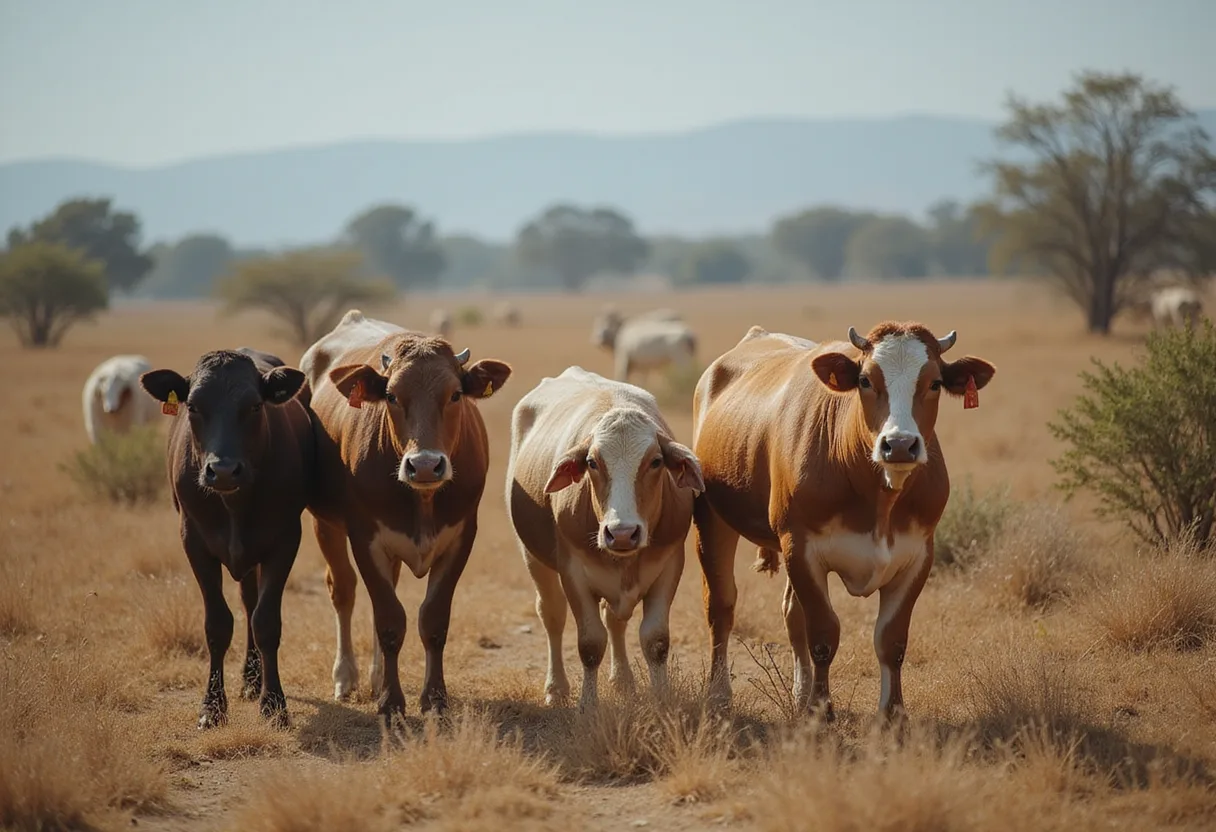
L-PRES deploys 760 veterinary experts to Kwara for livestock push
L-PRES has dispatched 760 veterinary experts to Kwara State under a deployment aimed at boosting livestock health, per Tribune Online. Dates, species focus, and funding remain unspecified in the source.
Updated
L-PRES has dispatched 760 veterinary experts to Kwara State under a deployment aimed at "boosting livestock health," according to Tribune Online.
The Nigerian outlet's headline and link text confirm three points only: the implementing entity (L-PRES), the personnel figure (760), and the operational objective (livestock-health improvement in Kwara). Dates, funding, and species focus remain absent from the source.
For a profession used to operating at sub-state densities, a single mobilization of 760 veterinary personnel into one Nigerian state stands out. The Tribune Online phrasing — "deploys" and "boost livestock health" — signals an active field operation rather than a recruitment or training event.
What does the deployment cover?
L-PRES is the named implementer. Kwara is the stated geography. "Boost livestock health" is the stated goal. That is the full factual inventory the source provides.
The release does not specify whether the 760 personnel are licensed veterinarians, animal-health paraprofessionals, or a mixed cadre. The composition matters because Nigerian veterinary regulation governs which clinical acts each cadre may legally perform. Without a cadre breakdown in the source, the clinical ceiling of the deployment cannot be modelled from the headline alone.
Why the 760 figure matters
Kwara State contains 16 local government areas. Spread evenly, the deployment yields roughly 47 personnel per LGA. Concentrated in priority livestock zones, per-area density climbs accordingly. Either distribution represents one of the larger single-state veterinarian mobilizations reported under Nigerian livestock programmes in recent coverage.
Operationally, a field force of this size can scale operations by an order of magnitude over routine state service:
- Vaccination drives move from pilot rounds to state-wide coverage within a single campaign window.
- Passive disease surveillance gains reach when more personnel staff livestock-dense wards.
- Producer training and extension visits, normally rationed by staff shortages, reach wider networks.
None of these operational specifics are confirmed in the source. They are the mechanisms through which a 760-person deployment typically alters animal-health delivery at field level.
What remains unclear
The headline does not address the operational questions practitioners and producers will ask next:
- Time horizon — single campaign, seasonal programme, or multi-year posting
- Funding source and budget envelope
- Species emphasis — cattle, small ruminants, poultry, swine
- Disease priorities — endemic control, single-pathogen vaccination, or open preventive service
- Reporting line between L-PRES, the Kwara State Government, and federal counterparts
Practice-level implication
For veterinarians already working in Kwara, the surge functions as either a coordinating partner pool or a workload supplement, depending on whether the contingent integrates with or runs parallel to existing state veterinary services. For producers, herd-level access to clinical and preventive care is likely to rise during the active deployment window. For public-health surveillance, a larger state-level veterinary presence raises the probability of earlier detection of zoonotic events, conditional on personnel submitting notifiable-disease reports.
Further bulletins from L-PRES or the Kwara State Ministry of Agriculture are needed to convert the 760 figure from a headline into an operational reality at the chute, the pen, and the kraal.
Source: Google News: Livestock health
Amara Osei
Show full bio
Correspondent covering companies, deals and strategy in Small- and large-animal clinical practice at The Vet Scope.
Related articles
780 Veterinary Experts Deployed to Nigeria's Rural Livestock Areas
FAO Backs South Africa's Push to Empower Veterinary Paraprofessionals
Gombe Begins Statewide Livestock Vaccination Campaign in Northeastern Nigeria
Indian UNMISS peacekeepers run veterinary clinics in Jonglei State
Gombe State launches statewide livestock vaccination campaign