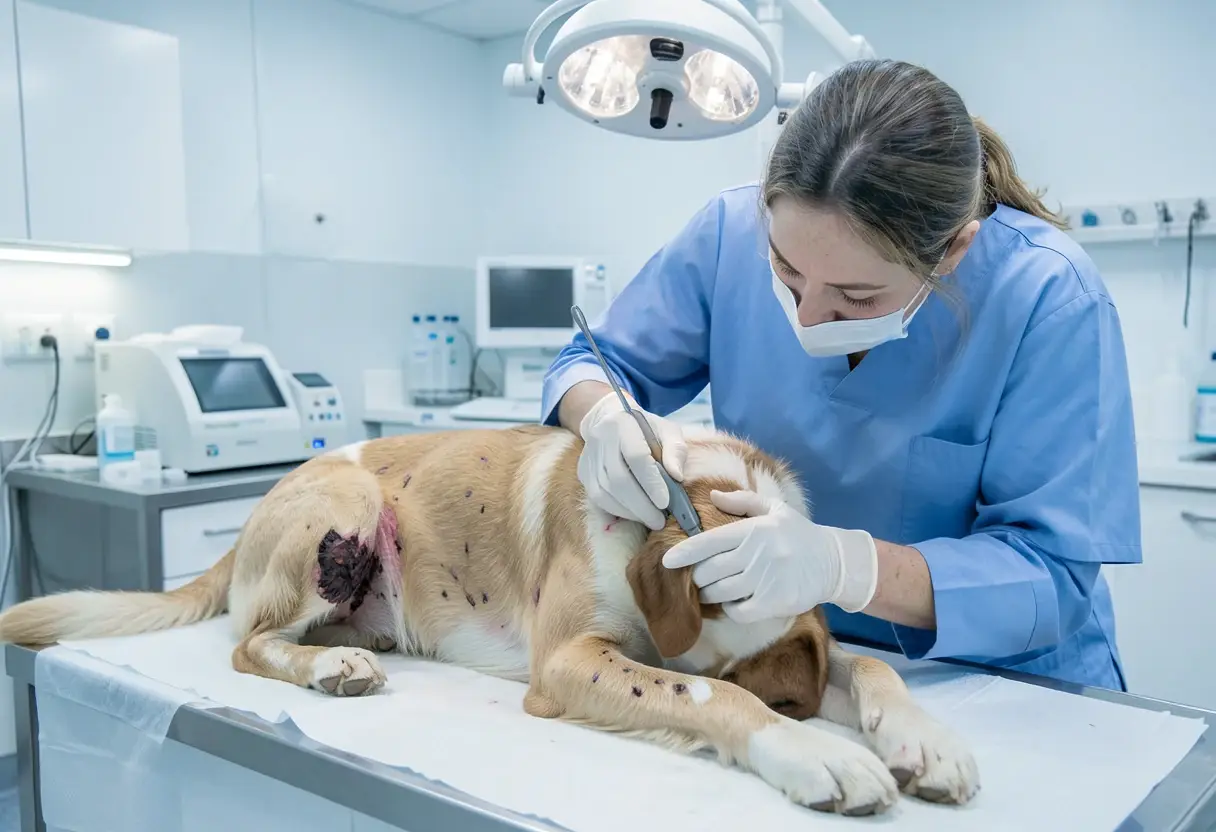
Canine Atopic Dermatitis Guidelines Rewritten for First Time Since 2015
ICADA's first cAD guideline rewrite since 2015 sorts therapies by mechanism, splits care into reactive and proactive phases, and adds ilunocitinib and atinvicitinib guidance.
Photo: AI-generated
The International Committee on Allergic Diseases of Animals (ICADA) published its first major rewrite of canine atopic dermatitis (cAD) treatment guidelines since 2015 on September 28, 2026, in Veterinary Dermatology. The update reviews evidence through July 2026 and grades every recommendation with the Strength of Recommendation Taxonomy (SORT), from SOR A, grounded in systematic reviews, meta-analyses, or at least two randomized controlled trials with similar findings, down to SOR D, based on expert consensus.
What changes at the exam table?
The 2010 and 2015 guidelines grouped treatments into acute flares, chronic lesions, and relapse prevention, ordered largely by how fast a drug acted. The 2026 authors, led by Ralf Mueller with Filippo Banovic, Emmanuel Bensignor, Domenico Santoro, and Tim Nuttall, argue that framework ignored how widely cAD varies between breeds, individual dogs, and disease stages. The rewrite sorts therapies by mechanism of action instead: skin barrier care, antimicrobial and microbiome-modulating therapy, allergen avoidance and allergen-specific immunotherapy, and anti-inflammatory or antipruritic drugs. It also describes each drug's spectrum of activity — a narrow-spectrum agent can stop severe pruritus while doing little for chronic inflammation or otitis.
What do reactive and proactive phases mean?
Treatment now falls into two phases. Phase 1, reactive therapy, resolves existing pruritus and lesions to reach clinical remission. Phase 2, proactive therapy, maintains that remission long term. The authors advise continuing reactive treatment at an effective dose until lesions and pruritus fully resolve — accepting some short-term adverse effects — because early adjustment risks a rapid rebound flare. Preventing flares likely prevents chronic changes that are harder to manage (SOR D).
For flares, topical glucocorticoids earned an A-level recommendation for flares, chronic lesions, and maintenance, as did oral prednisolone, prednisone, or methylprednisolone, with caution for long-term use. Long-acting injectable glucocorticoids should be avoided where possible because the dose cannot be tapered. Cyclosporine and topical tacrolimus are not recommended for flares owing to slow onset; antihistamines are not suggested for reactive treatment (SOR B). The authors advise against prolonged concurrent use of oral glucocorticoids, cyclosporine, and oclacitinib in any combination, citing a theoretical risk of severe opportunistic infections and neoplasia (SOR D).
How do the three JAK inhibitors compare?
Oclacitinib (Apoquel; Zoetis) received an A-level recommendation for flares and maintenance. Its activity is likely semi-broad spectrum, so dogs with otitis or pododermatitis may need additional therapy; pruritus can flare when dosing drops from twice to once daily, and a 4-day prednisolone course at the start may reduce that rebound.
Ilunocitinib (Zenrelia; Elanco), a pan-JAK inhibitor, also earned an A-level recommendation, with possibly broader activity (SOR B). In one double-blinded head-to-head trial cited in the guidelines, ilunocitinib lowered pruritus scores significantly more than oclacitinib after day 14 and clinical scores after day 28, a difference persisting through day 112. Safety data beyond 6 months are not available. The FDA recommends stopping ilunocitinib before and after vaccination in the US — a step the guidelines note is not required in the EU, UK, and other countries.
Atinvicitinib (Numelvi; MSD/Merck), a JAK1-selective inhibitor, received a C-level recommendation; its efficacy data come only from published abstracts, and long-term safety data are lacking.
For both oclacitinib and ilunocitinib, the guidelines recommend periodic complete blood counts, serum biochemistry, and — where susceptibility warrants — urinalysis, though no consensus exists on frequency.
Where does lokivetmab fit?
Lokivetmab (Cytopoint; Zoetis), a monoclonal antibody against canine interleukin 31, earned an A-level recommendation for flares and maintenance, especially where pruritus dominates. Its activity is likely narrow spectrum: itch falls quickly, lesions resolve more slowly, and dogs with otitis or pododermatitis will need more. Its safety profile suits combination therapy and dogs that cannot take other anti-inflammatory drugs (SOR C).
What maintains remission?
Once signs are in remission, options widen to barrier support, infection control, allergen avoidance, AIT, topical glucocorticoids, cyclosporine, topical tacrolimus, lokivetmab, and JAK inhibitors. In one small randomized controlled trial, hydrocortisone aceponate spray applied 2 consecutive days weekly maintained remission a median of 115 days versus 33 days for placebo. Cyclosporine earned an A-level recommendation for maintenance, with benefit taking 2 to 4 weeks, up to 6. Weekly bathing (SOR A), essential fatty acids (SOR A — which reduced needed doses of prednisolone, cyclosporine, and oclacitinib in 3 randomized trials), and year-round flea control in endemic regions round out support.
AIT is recommended for all dogs with environmentally triggered cAD (SOR B); 50% to 80% of dogs treated 6 to 12 months improve or need fewer antipruritics, and response should be judged only after at least 1 year.
The guidelines recommend restriction-provocation diet trials of 6 to 10 weeks (SOR A) for nonseasonal cAD, since no serologic or intradermal food-allergy test reliably predicts results. Antimicrobial "pulse" therapy must be avoided; probiotic evidence remains limited (SOR B); low-level laser therapy and fluoxetine showed no benefit in randomized trials.
The authors stress the interventions are "neither universally required, interchangeable nor effective in all cases." All 5 authors disclosed consulting, lecture, or research ties to animal health companies, including makers of drugs discussed; the guidelines were self-funded. How quickly the two newer JAK inhibitors move from C- and B-level evidence to firmer standing will depend on the long-term safety data now being gathered.
Source: dvm360.com
Nathan Brooks
Show full bio
Senior reporter covering companies, deals and strategy in Small- and large-animal clinical practice at The Vet Scope.
Related articles
RECOVER 2026 First Aid Guidelines: 50 Recommendations That Change Triage
Three New Antiallergy Drugs Reshape Canine Atopic Dermatitis Care
EMA Publishes 2025 Veterinary Medicines Annual Report
FDA Approves New Drugs for Bovine Respiratory Disease and Skin Infections
Dog Longevity Pill Nears FDA Approval: What It Will and Won't Do